

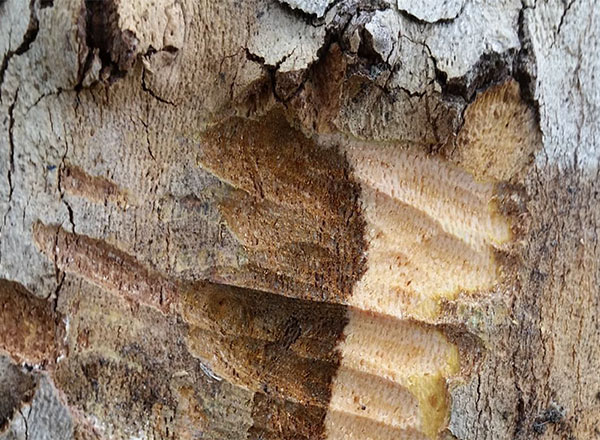



 People in parts of London and Berkshire are being reminded not to touch caterpillars of the oak processionary moth (OPM), which are beginning to emerge in oak trees in these areas.
They are also advised to keep children, pets and livestock away from the caterpillars and their nests, which can cause health problems, and to report any sightings.
Affected areas are several boroughs in West and South-West London, Bromley and Croydon in South London, Elmbridge in Surrey, and Pangbourne in Berkshire.
OPM caterpillars are a tree pest which was accidentally introduced to Britain. They feed on oak leaves, and in large numbers they can severely defoliate trees and leave them vulnerable to other pests and diseases.
Their tiny hairs contain a protein which can cause itchy skin rashes, eye and throat irritations and, occasionally, breathing difficulties, in people and animals. The hairs can be blown on the wind, and left in their nests in and under oak trees. The greatest risk period is May to July, although nests should not be approached at any time.
The Forestry Commission, Councils and land managers are tackling the pest with a carefully controlled programme of tree treatment and nest removal. Ian Gambles, the Forestry Commission's Director England, said that monitoring at the end of last year’s government-funded control operations showed signs of significant improvement, including:
• a 53% reduction in nest numbers, from 10,163 in 2012 to 4756;
• a slowdown in the rate of spread of the London outbreaks to 17 per cent compared with a 54 per cent increase the previous year; and
• no nests found in Pangbourne, Berkshire, compared with four in 2012 and 61 in 2011, indicating that the Pangbourne outbreak might be close to eradication.
Mr Gambles said the public had a valuable role to play in helping to control the pest by reporting sightings, but advised caution.
“We welcome reports of the caterpillars or their nests from the public or others, such as gardeners, tree surgeons and groundcare workers, who are out and about near oak trees,” he said.
“However, they should not try to remove the caterpillars or nests themselves. This needs to be carefully timed to be effective, and is most safely done by specially trained and equipped operators.”
Dr Yvonne Doyle, London Regional Director of Public Health England, endorsed this advice, saying:
“We strongly advise people not to touch or approach the caterpillars or their nests because of the health risks posed by the toxin-containing hairs. Pets can also be affected, and should be kept away as well. If you would like to know what these caterpillars look like, please see the Forestry Commission’s website for pictures.
“See a pharmacist for relief from milder skin or eye irritations following possible OPM contact, or consult a GP or NHS111 for more-serious reactions. Contact a vet if pets are affected.
“We have issued advice to local GPs and health professionals to help them identify when patients have been affected by the caterpillars and to advise them on appropriate treatment.”
Trees are treated by fully qualified operators under strict health, safety and environmental controls to ensure it is safe for people and animals.
• Sighting reports can be sent to the local council, or to the Forestry Commission via its Tree Alert app or on-line form available from www.forestry.gov.uk/opm, or by email to This email address is being protected from spambots. You need JavaScript enabled to view it..
• Health advice is available from the “Insects that bite or sting” area of the NHS Choices website, www.nhs.uk/livewell.
• Working on oak trees – Anyone having oak trees pruned or felled in the affected areas must contact the Forestry Commission’s Plant Health Service beforehand on This email address is being protected from spambots. You need JavaScript enabled to view it. or 0300 067 5155 for advice about safe removal of the material.
Further information is available from www.forestry.gov.uk/opm












